

What are you prepared to do in order to belong?
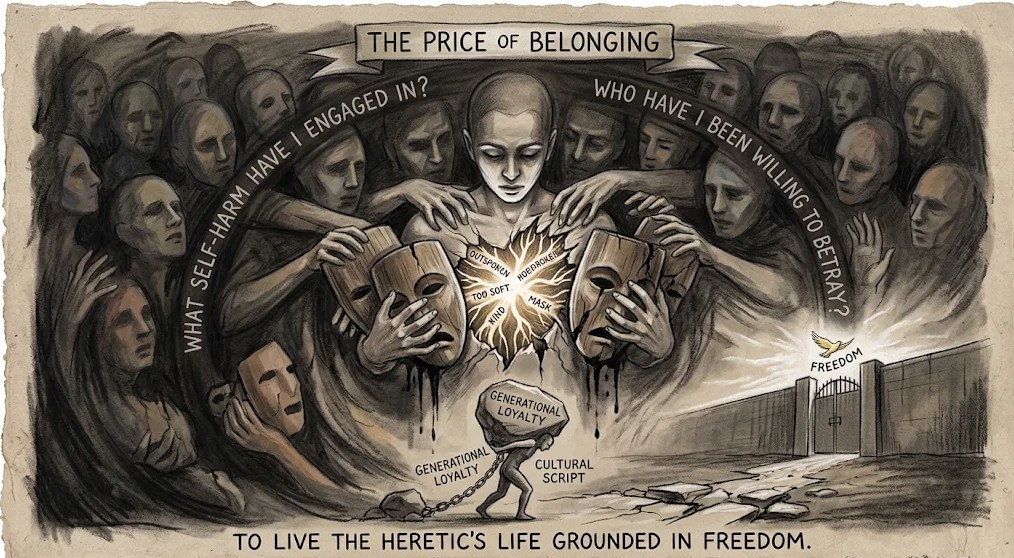
The need to belong is a core human need. It runs so deep that we’re compelled at times to do anything, deny anything. We strive to become something, present a mask, just to feel accepted and that we belong. This compulsion to belong, based on generations of survival strategies, can lead us towards believing in the harmful and engaging in the despicable. However, the principal betrayal remains the harm we do to ourselves as we sever, hide, suppress or otherwise dent essential parts of ourselves. Within our family system or culture, have we been labelled too soft, too kind, too masculine, too feminine, too outspoken?
We learn to hide in order to comply and belong – this has long-term effects and can span many generations. Just how many of our ancestors needed to deny their essential selves in order to fit in with the agreed rules of the culture they were raised in? How many were forced into marriages they didn’t want? How many had careers thrust upon them that were not desired? Religious and political ideologies have been the architects of exclusion, and we learnt at a very young age who was to be loved, who was to be rejected, what was acceptable and what was needed to be rejected, and to such an extent that we ourselves have been willing to commit terrible acts of violence towards ourselves in order to comply and belong.
However, in addition to self-harm, we also see that in the deep need to belong, many people are willing, in their desperate need to find a ‘home’ of belonging, to adopt exclusionary belief systems or, in its extreme, commit despicable acts of violence and cruelty in all good conscience as they exercise the will and impulse of the group that they are desperate to belong to. Taking all of this into consideration, we must be willing to ask ourselves: What have I been willing to do in order to belong? What self-harm have I engaged in simply to comply and belong to either my family or social group? Who have I been willing to betray in order to belong through the lens of exclusion?
Often, as children, we’re handed not only a script, but also a map of what our lives are supposed to look like – much of which is done through subtle messaging, but also through direct command. And then on top of that, we also feel compelled to be loyal to those who came before – perhaps a loyalty to those who had no freedom through denying ourselves the freedom we so long for, perhaps we become fiercely loyal to an exclusionary political or religious ideology as has been adhered to for generations in our family.
In order to answer those questions, it requires us to be courageous beyond what we’ve become accustomed to – courageous enough to release our loyalty. We need to have courage not to fight for our place in the group, but rather have the courage to risk losing our place in the group. When we stop hiding the parts of ourselves that were deemed unacceptable, we inevitably bump up against the unwritten rules of our family or culture. There is a very real grief in this, and often a deep sense of guilt, because stepping outside the script feels like betrayal.
True belonging can never be built on self-abandonment. When we stop hiding the parts of ourselves that were called “too much” or “wrong”, we can run into rules nobody ever quite admitted were there. Belonging begins the moment we are willing to stand in who we actually are, even if that means standing alone for a while. That takes tremendous courage. When belonging is conditional on who we reject, whether that is a part of our own nature or another human being, it is not true belonging at all: it is simply compliance held together by fear. We should not have to abandon ourselves in order to ‘belong’. This entire process starts with being more honest with ourselves about who and what we are, without even knowing how others will respond. If being accepted means rejecting a part of ourselves – or rejecting others – then it behoves us to ask what acceptance is truly costing us.
Seeing all of this clearly does not mean we turn our backs on those who came before us, or judge them for the survival strategies they had to adopt. They did what they needed to do in the world they were born into. However, loyalty does not require us to repeat their suffering or carry their exclusions forward. We can bow to their lives, acknowledge the price they paid to survive, and still choose differently for ourselves. In fact, perhaps the greatest gift we can offer those who had no freedom is to actually live the freedom they were denied.
Sometimes, we must be willing to live the heretic’s life, grounded in freedom.
© Shavasti (John L. Payne). All rights reserved. You are welcome to freely quote and share this article, provided that full credit and attribution are explicitly given to the author and the original source: Shavasti (John L. Payne) — familyconstellations.net.