

The Inherited Fear of Being Seen
The Inherited Fear of Being Seen
In many of my workshops, fear of visibility—or the recognition of self-sabotage as a pattern that seeks to avoid visibility—is a common theme.
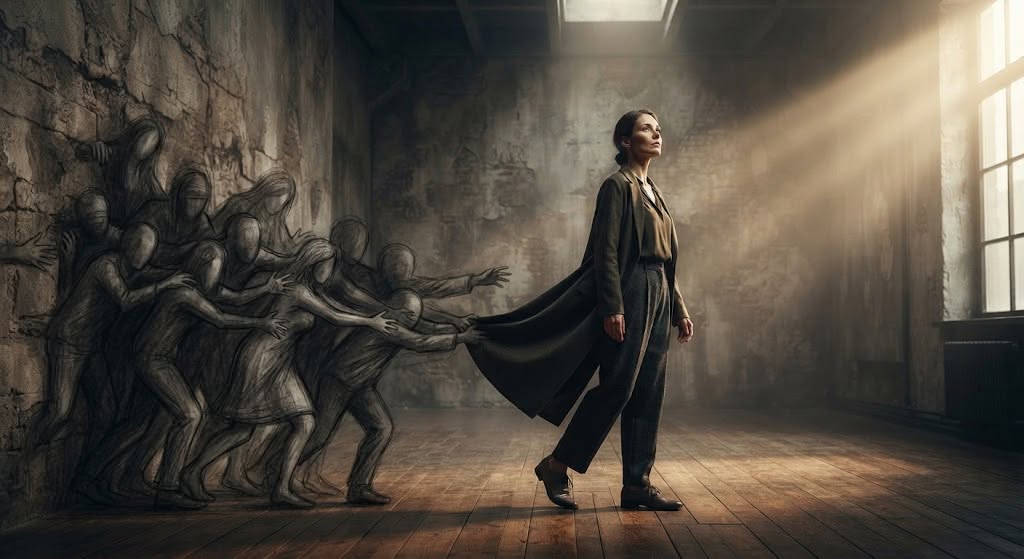
For many women, the fear of visibility is often not only a loyalty to the women in their lineage who were silenced, punished or erased for being visible or outspoken, but also a deeply held fear passed down through generations of the consequences of visibility. For many centuries, women who stepped outside traditional submissive roles as writers, healers, scientists or political agitators faced severe consequences – alienation, ostracisation and, in its worst form, the history of witch burnings. All of this sits in our bones.
For men, the fear of visibility is often a loyalty to the men who were shamed, ridiculed or punished for showing emotion, vulnerability or for stepping outside rigid gender roles or notions of traditional masculinity. Men often survived by becoming stoic, guarded and emotionally unexpressed, holding onto the belief that ‘visibility exposes you’. Historically, it is deeply damning of our culture to know that men suffering from extreme trauma were branded as cowards and lacking moral fibre and fortitude, with some even executed for desertion or cowardice. Such is the imprint: feelings equal weakness.
All of this leaves a virtually identical systemic imprint that declares that visibility is not only dangerous, but life-threatening. It doesn’t declare that visibility is dangerous in the present; it holds onto the deep memory that visibility was dangerous in the past. Inside us live the annals of history that state clearly: visibility is dangerous.
Very often, we don’t freeze owing to a lack of confidence or ability, but because, in our lineage, someone paid a very high price for their visibility, and this experience has been carried forward long after the original event. For women, this carries the echoes of mothers, grandmothers and great-grandmothers who were punished, silenced or erased for simply having an opinion or challenging authority. For men, this carries the generational imprint of fathers, grandfathers and great-grandfathers who were shamed, bullied and ridiculed for showing creative expression, emotion, vulnerability or sensitivity.
Visibility can still feel dangerous today because of what happened in the past – many of us are living the echoes and scripts of past generations, and we’ve learnt that, in order to survive, we need to belong; and, in order to belong, we need to be compliant. That often translated into silence and invisibility.
When we choose to be visible, it invariably invites criticism from someone, somewhere, it always invites friction – that is also true. The question we must ask ourselves is: ‘Is my response proportional in this moment, or am I reacting disproportionately owing to the systemic imprint?’ In other words, is there a real and present danger, or is this the voice of my grandmother in my bones?
When we look at this, it’s important to become aware of two real possibilities:
- Am I being loyal to those who were not free to express themselves?
- Is my fear of visibility based on real systemic history, and therefore is it an inherited response?
Or simply a combination of the two.
Who are you to rise above those who needed to be small in order to survive? Who are you to shine, expand and thrive in the presence of such suffering and constriction? The voices of guilt and fear can be strong, but through our constellation work, we can bring them into the light of consciousness and start to dissolve the unspoken vows of silence and compliance.
When we turn towards those who were silenced with a deep respect for their fate, our visibility ceases to feel like a betrayal. Instead, it becomes a movement that says, “What was not possible then is possible now.” It becomes a gift to the family system, allowing the ancestors to say, “Finally, one of us is free. Let us smile upon them.” This is the moment when visibility becomes an act of belonging, no longer one of betrayal.
I bow, I bow, I thrive
© Shavasti (John L. Payne). All rights reserved. You are welcome to freely quote and share this article, provided that full credit and attribution are explicitly given to the author and the original source: Shavasti (John L. Payne) — familyconstellations.net.