

The Closed Room Effect
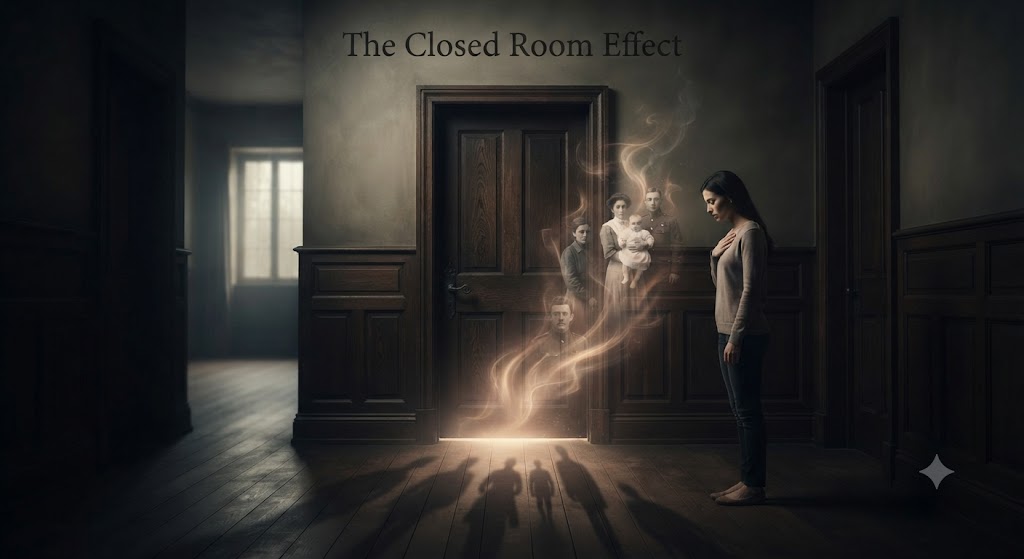
Over my many years of working with individuals—both in private sessions and workshop settings—I have become acutely aware of what I term the “Closed Room Effect.” The closed room is where the forgotten, the excluded, the denied, and the “I’d rather not know” are relegated.
Even when we ask specific questions such as, “Is there anyone missing in your family?”, “Did anyone die young or tragically?”, or “Has someone been cast out?”, the answer frequently comes back as, “Not as I recall.” Even when we specify, “Not only your family of origin, but in your mother’s or father’s family,” the answer often remains, “Not that I know of.”
It is vital to observe the body, for it never lies; frequently, what the client isn’t saying is far more important than what they are saying at times. Sometimes I will say to a client, “I noticed that your breathing changed when you spoke of your mother’s family. What happened there?”
The Closed Room is often filled with what does not want to be felt, what does not want to be seen, or what has been forbidden.
I am no longer surprised when, five minutes into a Constellation, I notice something, and upon further enquiry, the client reveals: “Well, my grandmother did die in childbirth; I never met her,” or “My father had a brother who went to war and never returned,” or “There’s a story about an aunt who was sent to an asylum and died there, but I don’t know if it’s true.” This is the Closed Room.
It is the room in which all of the family’s unprocessed grief lives. It is the room full of family secrets and shame. The clients are not lying; they are loyal to the Closed Room. Our job is to gently approach that door and invite them to take a look—perhaps even to walk inside and feel what has been waiting there all along.
The Closed Room is loyalty to silence; it is the avoidance of that which may be overwhelming; it is the difficulty in looking at exactly what is. We often convince ourselves that the most significant events are not important enough to be mentioned.
The Gift of Opening the Door
Ultimately, the Closed Room is not a place of malice, but a place of protection. By keeping these events hidden, the family system has been attempting to shield itself from pain. However, true healing only begins when we acknowledge the truth. When we dare to open the door, we do not find disaster; we find the missing pieces of our own identity. By bringing the unspoken into the light, we move from the loyalty of silence to the freedom of resolution, allowing the life force that was once tied up in maintaining the secret to flow freely once again.
© Shavasti (John L. Payne). All rights reserved. You are welcome to freely quote and share this article, provided that full credit and attribution are explicitly given to the author and the original source: Shavasti (John L. Payne) — familyconstellations.net.