

Dear Mother – When you speak badly of Father, you shame me
Dear Father – When you speak badly of Mother, you shame me
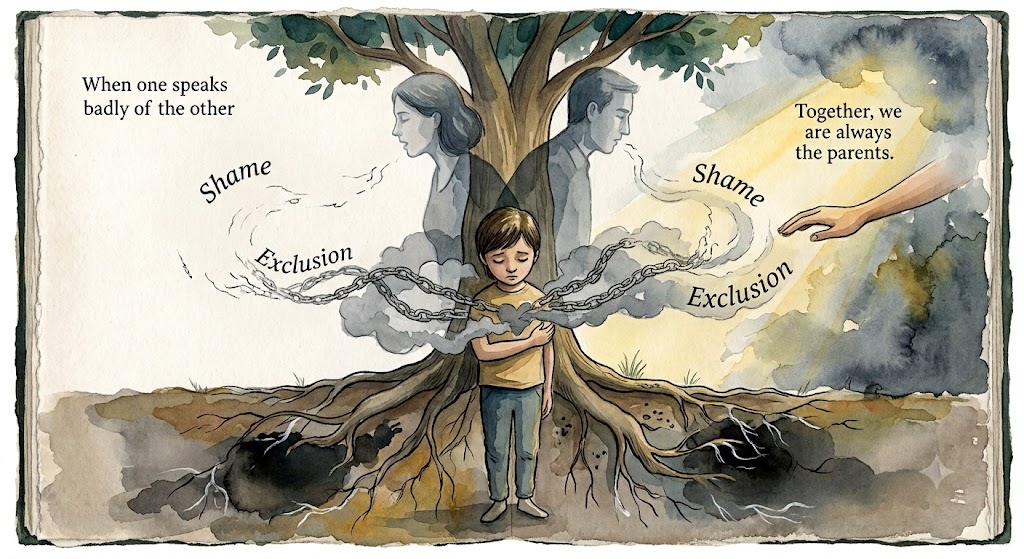
What you say about each other is what I often feel about myself.
When one parent speaks badly of the other they can trigger two deep systemic wounds to the child’s core identity, namely ‘I did something bad by loving my father’ or ‘I am bad because I carry my mother within me’. Conflict is never contained between adults, no matter how strongly we may claim that it is – all is felt by the children. There aren’t really secrets in families. Children just don’t hear words, they sense exclusions, no matter how subtle and unspoken resentments, they don’t need words to inform them, they respond to what is unspoken. From a systemic point of view, children can then end up carrying all that which is excluded and all the unexpressed tension as anger, guilt, shame, anxiety or behavioural symptoms.
Because a child inherently knows that they are composed of both parents, when the other is labelled as bad, the child internalises this and feels a split loyalty where loving one parent feels like a betrayal of the other. Additionally, as we’ve observed systemically, a child could represent the excluded parent through imitating the disparaged parent – this is a fairly common observation. All of this can show up within us as adults and in our adult relationships. When we carry the shame of the rejected and disparaged parent, this can manifest in various ways: difficulties in trusting partners; low self-worth or imposter syndrome; the inner statement, ‘I am not worthy of love’; or the core belief, ‘I am fundamentally flawed’ – even to the extent of carrying a deep-seated sense of anger or injustice that doesn’t feel entirely ‘theirs’.
What is required here is that there is recognition from the parents with the statement ‘together, we are always the parents’ – this separates out the couple relationship from the permanent parental relationship offering relief to the child with the knowledge that the possible dissolution of the couple relationship does not mean the loss of a parent or parents. Another important healing movement can be for the parents to say ‘I honour the part of your father I see alive in you’. Over the years I have guided many parents through this process of affirming the child through saying things like ‘your creative talent, you get that from your mother and it’s nice to see’.
From the child’s position, what is required is to truly leave the conflict with the parents, avoiding the trap of splitting ourselves into viewing one as the ‘good parent’ and the other as ‘the bad parent’. The movement is to take both exactly as they are so that we may feel whole.
© Shavasti (John L. Payne). All rights reserved. You are welcome to freely quote and share this article, provided that full credit and attribution are explicitly given to the author and the original source: Shavasti (John L. Payne) — familyconstellations.net.